
A valve amplifier is one of the most rewarding pieces of audio equipment you can own. The warm, rich tone that only tubes can produce is something no digital emulation has fully replicated, and for musicians, audiophiles, and home theatre enthusiasts across the Sunshine Coast, a well-maintained valve amp is a long-term investment worth protecting.
But valve amplifiers are also more complex and more demanding than solid-state alternatives. When something goes wrong, and it will eventually, knowing the common causes of failure makes the difference between a straightforward valve amplifier repair and a costly write-off. At Brocky’s Electronics, we’ve repaired hundreds of valve amplifiers across the Sunshine Coast, from vintage hi-fi units to modern guitar amps and studio monitors. Here’s what causes them to fail and what to do about it.
The Most Common Valve Amplifier Problems We See
1. Worn Out or Failing Valves (Tubes)
Valves are consumable components. Unlike solid-state electronics, they have a finite service life and will eventually need replacing regardless of how well the amplifier is maintained. Most power valves last between 1,000 and 3,000 hours of use depending on the type and operating conditions. Preamp valves typically last longer but will still degrade over time.
Signs your valves need replacing:
- A noticeable loss of volume, clarity, or warmth in the sound
- Crackling, microphonic noise, or intermittent signal on one or more channels
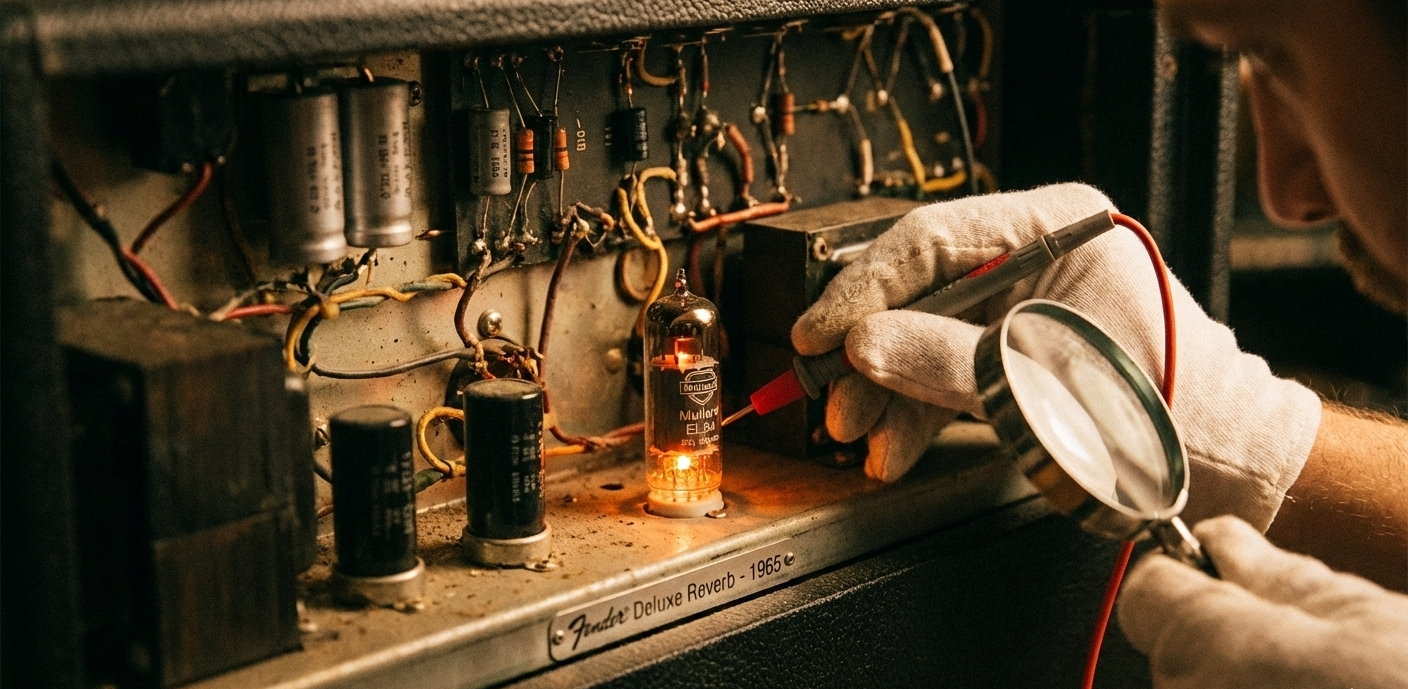
- A visible red glow inside a power valve that’s unusually bright or uneven
- The amplifier goes into protection mode or blows fuses repeatedly
What to do:
- Have your valves tested by a qualified technician before replacing them
- Always replace power valves as a matched set to maintain correct bias
- Preamp valves can often be replaced individually
Attempting to replace valves without correctly setting the bias afterwards can cause further damage to the output transformer and other components. This is a job for a professional valve amplifier repair technician.
2. Bias Drift and Incorrect Bias Settings
Bias is the operating voltage applied to the output valves. It needs to be set correctly for the amplifier to run efficiently, produce the right sound, and avoid damaging the output transformer. Over time, as valves age and internal components drift, the bias shifts away from its optimal setting.
What you’ll notice:
- The amplifier running hotter than usual
- Reduced output power and tonal quality
- Power valves glowing unusually bright or dim
- Blown fuses occurring more frequently
Bias adjustment requires a multimeter, access to the amplifier’s internal test points, and a thorough understanding of high-voltage circuits. The voltages present inside a valve amplifier are lethal, even when the unit is switched off. This is not a DIY task under any circumstances.
3. Blown Fuses
A blown fuse is often a symptom rather than the fault itself. While replacing a fuse seems straightforward, fitting a higher-rated fuse to stop it blowing is one of the most damaging things you can do to a valve amplifier. It removes the only protection the circuit has against a more serious fault.
Common causes of blown fuses:
- A failing output valve drawing excessive current
- A short circuit in the output stage
- A failing power supply capacitor
- Incorrect valve substitution
What to do:
- Replace with the exact fuse rating specified on the amplifier’s fuse holder or documentation
- If the fuse blows again immediately, there is an underlying fault that needs professional diagnosis
- Never substitute a higher-rated fuse
4. Humming, Buzzing, or Noise Floor Issues
A low-level hum is acceptable in many vintage valve amplifiers, but a loud persistent hum or buzz that interferes with the signal is a fault that needs attention. These are among the most common complaints we diagnose during valve amplifier repair on the Sunshine Coast.
Common causes:
- Failing or dried-out filter capacitors in the power supply
- Ground loop interference from connected equipment
- A failing or microphonic valve
- Damaged or deteriorated wiring inside the amplifier
What to do:
- Swap input cables and sources to rule out an external ground loop first
- If the hum is internal and consistent, the power supply capacitors are the most likely culprit
- Capacitor replacement in valve amplifier power supplies involves lethal voltages and must be handled by a qualified technician
Power supply filtering is critical to low-noise operation in any valve design, and degraded filter capacitors are one of the leading causes of persistent hum, something well documented in valve amplifier circuit theory for anyone wanting to go deeper on the technical side.
5. Output Transformer Failure
The output transformer is one of the most critical, and most expensive, components in a valve amplifier. It matches the high-impedance output of the power valves to the low-impedance speaker load. When it fails, the amplifier either produces no output at all or a severely distorted signal.
Signs of output transformer failure:
- Complete loss of output on one or both channels
- Severe distortion or buzzing with no clean signal present
- A burning smell, particularly during use
- A fuse that blows repeatedly even after valve replacement
Output transformer failure is often caused by a failed output valve that was left running without attention, allowing excessive current to flow through the transformer windings. Early valve amplifier repair when valve faults first appear prevents this more expensive secondary failure.
6. Deteriorated Capacitors and Passive Components
Capacitors, resistors, and other passive components inside valve amplifiers age over decades. Electrolytic capacitors in particular dry out, losing their capacitance and increasing their equivalent series resistance, which affects both sound quality and circuit stability.
What you’ll notice:
- Gradual degradation in sound quality over time
- Increased noise floor or hum
- The amplifier behaving differently as it warms up versus when cold
- Intermittent faults that come and go
A full capacitor refresh, sometimes called a recap, is a common and worthwhile valve amplifier repair for instruments more than 15 to 20 years old. It restores performance, improves reliability, and significantly extends the service life of the amplifier.
Keeping power valves inspected, bias checked regularly, and capacitors refreshed on older units are the habits that separate a well-maintained amp from one heading for an expensive fault, something Reverb covers well for musicians wanting to go deeper on the practical side of tube amp care.
When to Stop Troubleshooting and Call a Professional
Valve amplifiers operate at voltages that are genuinely lethal, typically between 300 and 500 volts DC in the power supply, and these voltages remain present in capacitors for extended periods after the amplifier is switched off and unplugged. These are clear signs your amplifier needs professional valve amplifier repair:
- Any fault involving the internal power supply or filter capacitors
- Blown fuses that recur after replacement
- No output or severely distorted output
- Burning smell or visible damage to internal components
- Bias-related symptoms including excessive heat or valve glow issues
- Any fault you’re not 100 percent certain how to diagnose safely
For television faults alongside your amplifier, TV repair on the Sunshine Coast is handled by the same experienced local team.
If your setup also includes DJ gear, maintaining DJ equipment properly between services makes a real difference to how long it lasts.
For a full professional assessment, valve amplifier repair on the Sunshine Coast covers everything from bias checks to full rebuilds.
At Brocky’s Electronics, we carry out valve amplifier repair on everything from vintage hi-fi integrated amplifiers and guitar amplifiers to professional studio power amps and preamplifiers across the Sunshine Coast.
Why Sunshine Coast Musicians and Audiophiles Trust Brocky’s Electronics
We’re a local workshop, not a mail-away repair centre. When you bring your amplifier to us, a qualified technician with real hands-on experience across valve and solid-state audio equipment assesses it honestly, explains the fault clearly, and talks you through every option before any work begins.
Here’s what you get with every valve amplifier repair at Brocky’s Electronics:
- Experienced technicians across all major valve amplifier brands and types
- Honest assessment, we’ll tell you if repair isn’t the right call
- Fast turnaround, because we know you need your amp working
- Genuine and correctly specified replacement components wherever possible
- Transparent, upfront pricing with no surprises
We’ll let the locals we’ve helped do the talking.
Book Your Valve Amplifier Repair Today
Don’t let a valve amplifier fault sit until it becomes something far more expensive to fix. Whether it’s a valve replacement, a bias adjustment, or a full capacitor refresh, the team at Brocky’s Electronics is ready to help.
From valve amplifier repair to televisions, digital pianos, and mixing consoles, you can find everything we do at Brocky’s Electronics.
Contact Brocky’s Electronics today and we’ll have your amplifier assessed and back in action as soon as possible.
FAQs
1. How often do valve amplifier tubes need replacing?
Power valves typically last 1,000 to 3,000 hours depending on use. Have them tested annually if you play regularly.
2. Can I replace valves myself?
You can swap valves, but bias must be reset afterwards. Incorrect bias damages the output transformer. Always have a technician set the bias after any valve change.
3. Why does my valve amplifier keep blowing fuses?
A recurring blown fuse means an underlying fault, usually a failing valve or power supply component. Never fit a higher-rated fuse, get the fault diagnosed first.
4. Is a valve amplifier hum normal?
A very low hum is common in vintage designs. A loud or worsening hum is a fault, usually a failing filter capacitor, and needs professional attention.
5. How long does a valve amplifier repair take?
Most repairs are completed within 3 to 7 business days. Complex faults or parts sourcing may take longer, and we’ll give you a realistic timeframe upfront.