
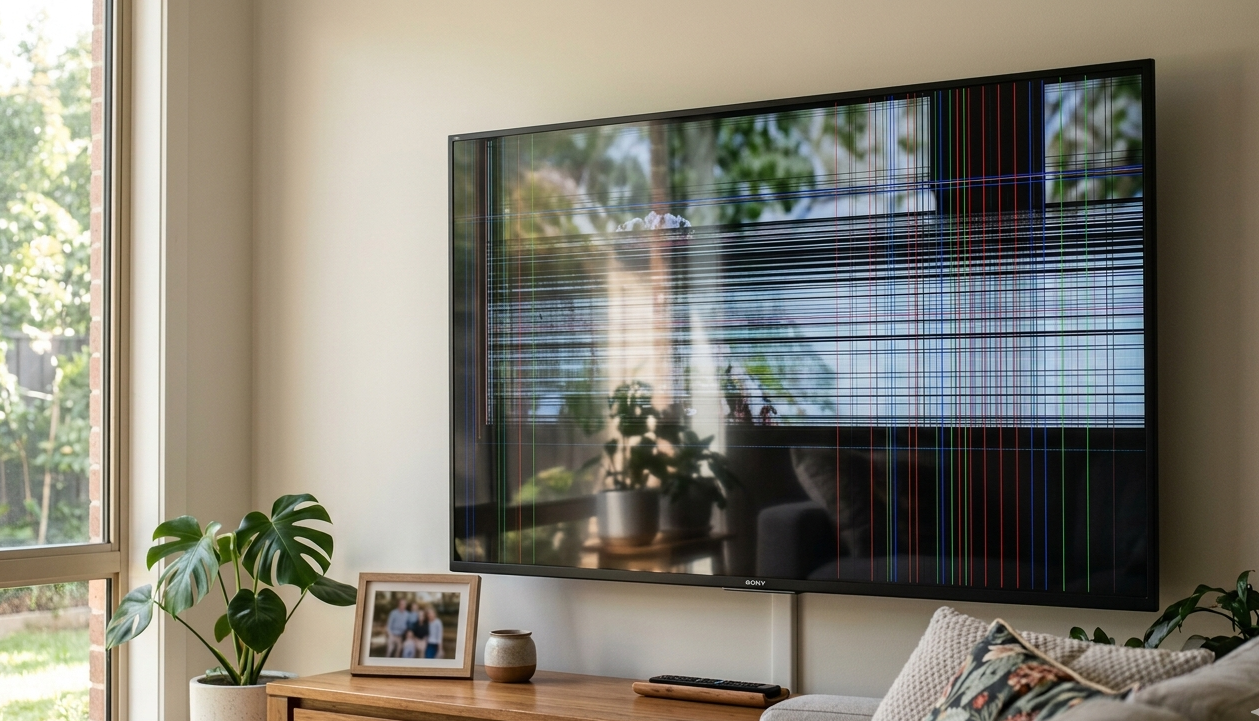
A line appearing on your TV screen is one of those faults that starts small and quickly becomes impossible to ignore. Whether it’s a single thin vertical stripe, a cluster of horizontal bands, or an area of the screen that’s gone completely dark, these faults rarely resolve on their own. And the longer they’re left, the more useful diagnostic information gets lost.
At Brocky’s Electronics, TV screen repair on the Sunshine Coast is one of our most regularly requested services. We work across all major brands and panel technologies, and we see the same fault patterns repeatedly. Here’s a clear breakdown of what causes TV screen lines, how to identify which type of fault you’re dealing with, and what repair actually involves.
What Causes Lines on a TV Screen?
TV screen lines fall into distinct categories, and each one points to a different internal component. Identifying the type of line you’re seeing before calling a technician helps narrow the diagnosis significantly.
Vertical Lines on a TV Screen
A single vertical line or multiple vertical lines running from the top to the bottom of the TV screen are among the most common faults we repair on the Sunshine Coast. They almost always point to one of these causes:
- A damaged or partially failed LCD panel where a column of pixels has stopped receiving a drive signal
- A loose or damaged ribbon cable connecting the panel to the T-Con board
- A failing T-Con board (timing control board) that drives the panel’s column drivers
- Physical pressure or impact damage to the panel causing localised pixel column failure
Vertical lines that flicker, change colour, or temporarily disappear when the television warms up often indicate a ribbon cable or T-Con board issue rather than panel damage. This is a more encouraging finding from a repair cost perspective.
Horizontal Lines on a TV Screen
Horizontal lines across the TV screen are less common but follow a similar diagnostic path. A band or stripe running across part of the screen typically indicates:
- A row driver failure on the LCD panel’s edge
- A gate driver IC fault on the panel
- Physical pressure damage to a specific area of the screen
- A main board fault affecting the panel’s row signal
Bands of Colour or Full-Screen Distortion
When lines or colour bands cover a large portion of the TV screen, or when the distortion shifts with different content, the fault is more likely in the main board or the connection between the main board and the panel rather than the panel itself.
Safe Checks to Try at Home Before Booking a Repair
A few straightforward checks at home can tell you a great deal about the nature of the fault before TV screen repair on the Sunshine Coast is booked.
1. Test Across All Inputs and Sources
Lines that appear only on a specific HDMI input or with a particular device connected are caused by the external device or cable rather than the television. Lines that appear across all inputs, including the television’s built-in apps and tuner, confirm the fault is in the TV screen or internal components.
What to do:
- Switch through every input including free-to-air, smart TV apps, and each HDMI port
- Try a different HDMI cable and port if lines only appear on one input
- Test whether the lines are present on the TV’s settings menu or home screen with no external input active
2. Perform a Picture Reset and Factory Reset
A corrupted picture setting or firmware glitch can produce visual artefacts that look like panel damage. Ruling this out is quick and costs nothing.
What to do:
- Navigate to Settings and reset the picture or image settings to factory defaults
- If lines persist, perform a full factory reset from the Settings menu
- Check for a firmware update for your specific model after resetting
3. Apply Light Pressure to the Back Panel Frame
This diagnostic step helps distinguish between a panel fault and a loose internal connection. With the television powered on and lines visible, apply gentle pressure to the back of the chassis near where the lines appear.
What to look for:
- Lines that temporarily shift, flicker, or disappear under light pressure indicate a loose ribbon cable or connector rather than panel damage
- Lines that show no response to pressure suggest panel damage is more likely
Do not apply pressure directly to the screen surface, as this risks causing further damage to an already stressed panel.
4. Check for Physical Damage
Examine the screen carefully for any visible cracks, impact marks, or areas of discolouration that coincide with where the lines appear. Physical damage to the panel, even impacts that don’t shatter the screen, can cause column or row driver failure in the surrounding area.
As covered in how LCD panel construction affects repairability, LCD panels are built from multiple layers including polarisers, colour filters, and liquid crystal arrays, making physical damage to any layer capable of producing visible line faults across a significant portion of the screen.
What Professional TV Screen Repair Involves
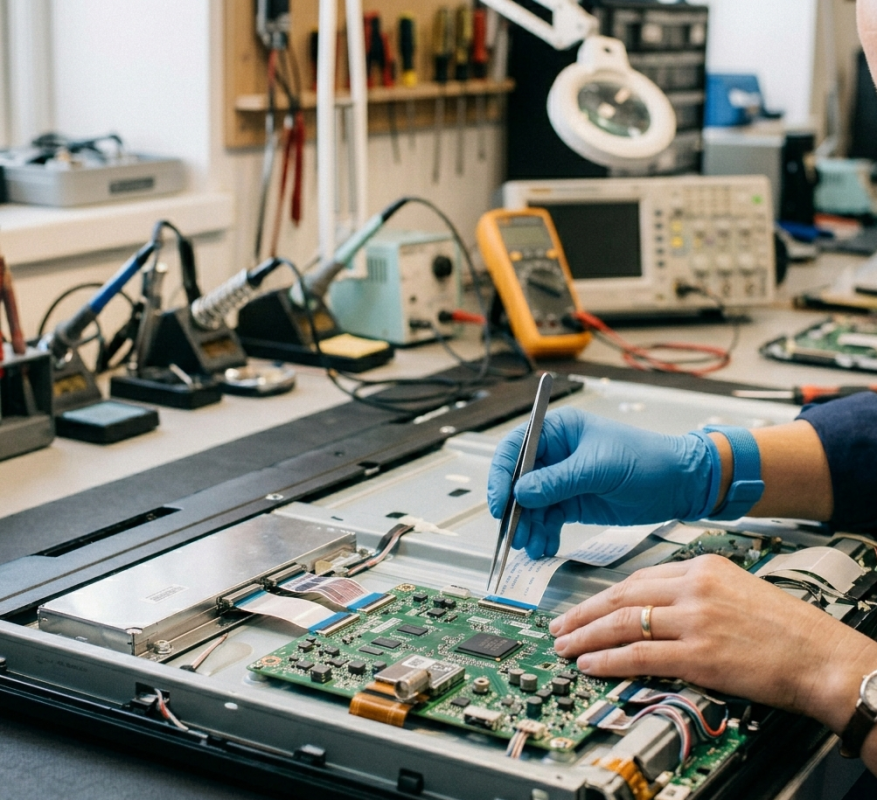
When you bring your television to Brocky’s Electronics for TV screen repair on the Sunshine Coast, a proper assessment covers:
- Visual inspection of the panel surface for physical damage, pressure marks, and impact points
- Input and source testing to rule out external faults
- T-Con board testing to determine whether the fault is in the board or the panel’s ribbon cables
- Main board assessment if the distortion pattern or colour banding suggests a signal fault
- Clear repair recommendation before any work begins, including an honest view on whether repair is cost-effective for your model
For screen faults specifically, the key distinction is between a panel fault and a T-Con board or ribbon cable fault. T-Con board and ribbon cable repairs are significantly more cost-effective than panel replacement, and confirming this distinction early determines whether repair makes financial sense.
For a broader look at what causes lines specifically, including how to identify T-Con faults versus panel damage in more detail, TV screen lines causes and checks covers the diagnostic steps in full.
For Sony televisions with TV screen faults, Sony TV repair on the Sunshine Coast covers model-specific fault patterns across Sony’s full LED and OLED range.
For all other brands, TV repair on the Sunshine Coast covers Samsung, LG, Hisense, TCL, Panasonic, and more across LED, OLED, and QLED technologies.
For further technical reference on how television display faults present and what they indicate about internal components, RTINGS’ TV troubleshooting guide is one of the most detailed consumer resources available for Australian TV owners evaluating a repair decision.
Is TV Screen Repair Worth It?
This is the question most Sunshine Coast households ask, and the honest answer depends on what’s actually causing the lines.
Repair is worth it when:
- The fault is in the T-Con board or ribbon cables rather than the panel itself
- The television is a quality brand under six to eight years old
- The screen size means replacement cost significantly exceeds repair cost
- Genuine or compatible replacement parts are available for your model
Replacement may make more sense when:
- The LCD or OLED panel itself has physically failed
- The fault affects a large portion of a smaller, lower-value screen
- Physical panel damage is extensive
A professional assessment gives you a clear, honest answer for your specific model before any work is committed.
Why Sunshine Coast Locals Trust Brocky’s Electronics
We’re a local workshop, not a mail-away repair centre. When you bring your television to us, a qualified technician with hands-on experience across all major TV screen technologies assesses the fault honestly and explains every option before any work begins.
Here’s what you get with every TV screen repair on the Sunshine Coast at Brocky’s Electronics:
- Experienced technicians across LED, OLED, QLED, and Smart TV repairs
- Honest assessment, we’ll tell you if replacement makes more sense
- Fast turnaround, because we know you need your television working
- Genuine and compatible replacement parts wherever possible
- Transparent, upfront pricing with no surprises
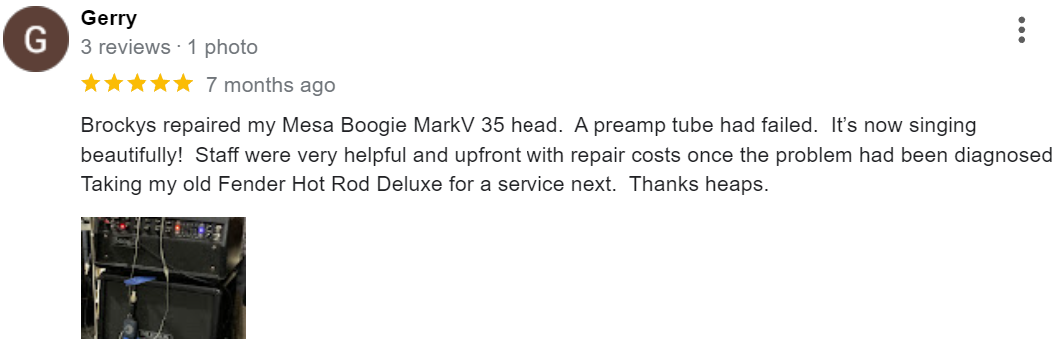
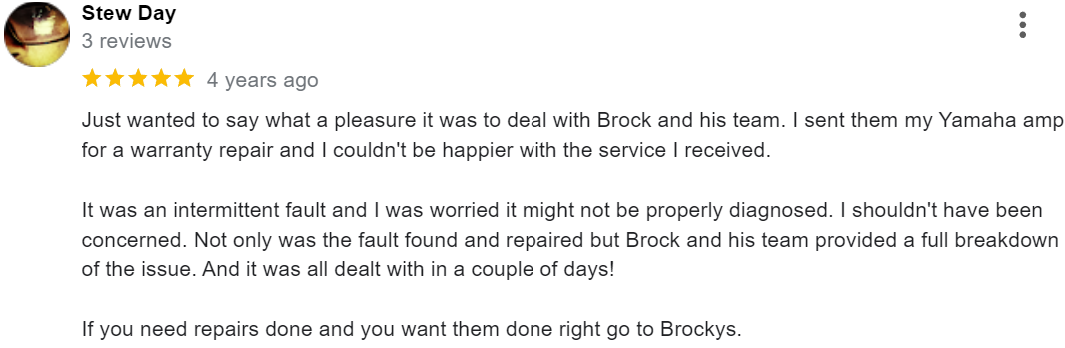
We’ll let the locals we’ve helped do the talking.
Book Your TV Screen Repair Today
Don’t leave TV screen lines to worsen or spread. Whether it’s a T-Con board replacement, a ribbon cable repair, or a full panel assessment, the team at Brocky’s Electronics is ready to help.
From TV screen repair on the Sunshine Coast to Sony repairs, digital pianos, and audio equipment, you can find everything we do at Brocky’s Electronics.
Contact Brocky’s Electronics today and we’ll have your television assessed and back in action as soon as possible.
FAQs
1. What causes vertical lines on a TV screen?
Vertical lines are usually caused by a T-Con board fault, a loose ribbon cable, or panel damage. Lines that flicker or respond to light pressure on the chassis often indicate a cable fault rather than panel failure.
2. Can TV screen lines be fixed without replacing the whole panel?
Often yes. T-Con board and ribbon cable repairs are significantly more cost-effective than panel replacement and resolve most line faults on the Sunshine Coast.
3. How do I know if my TV screen lines are a panel fault or a board fault?
Gently apply light pressure to the back of the TV chassis near the lines. If lines shift or disappear temporarily, a loose connection is likely. If there’s no response, panel damage is more probable.
4. Is it worth repairing a TV with screen lines?
For quality brands under six to eight years old where the fault is in the T-Con board or cables, yes. Panel replacement cost versus the TV’s current value determines whether repair makes sense for older or lower-value models.
5. How long does TV screen repair take on the Sunshine Coast?
Most repairs are completed within 3 to 7 business days. Parts availability may extend this for less common models, and we’ll always give you a realistic timeframe upfront.