
Your music equipment is an investment. Whether you’re a gigging musician, a home studio enthusiast, or a teacher running lessons from your Sunshine Coast home, the gear you rely on needs regular care to perform at its best and last as long as it should. The good news is that most music equipment faults are either preventable with basic maintenance or identifiable early enough to be repaired before they become expensive.
At Brocky’s Electronics, we carry out music equipment repair on the Sunshine Coast on everything from mixing consoles and valve amplifiers to digital pianos, studio monitors, and PA systems. Here’s a practical guide to keeping your gear in top condition and knowing when to bring it in for professional attention.
Why Music Equipment Maintenance Matters More on the Sunshine Coast
The Sunshine Coast’s warm, humid coastal climate creates conditions that are harder on music equipment than most manufacturer specifications account for. Salt air accelerates corrosion on metal contacts, connectors, and circuit board traces. High humidity causes wooden components to swell and electronic components to degrade faster than in drier inland environments.
Proactive maintenance is the most cost-effective approach to keeping music equipment performing reliably in this environment. Here’s what to prioritise.
Essential Maintenance Tips for Music Equipment
1. Keep Equipment Clean and Dust-Free
Dust accumulation inside music equipment is one of the most damaging and most overlooked maintenance issues for Sunshine Coast musicians. Dust acts as an insulating layer over heat-generating components, traps moisture, and accelerates wear on mechanical parts like faders, knobs, and key mechanisms.
What to do:
- Use compressed air to clean vents, fan intakes, and keyboard mechanisms every three to six months
- Wipe external surfaces with a dry or slightly dampened microfibre cloth regularly
- Keep equipment covered when not in use, particularly in rooms that aren’t climate controlled
- Store equipment in cases or covers when not actively being used
2. Control the Environment Around Your Equipment
Where and how you store your music equipment has a direct impact on its longevity, particularly on the Sunshine Coast where temperature and humidity fluctuate significantly between seasons.
What to do:
- Keep instruments and electronics in climate-controlled rooms where possible
- Avoid storing equipment in garages, sheds, or unventilated rooms where humidity accumulates
- Use a dehumidifier in your practice or studio space during humid summer months
- Allow equipment that’s been stored in a cooler environment to reach room temperature before powering on, as condensation inside a cold device can cause short circuits
3. Clean and Maintain Cables and Connectors
Cable and connector faults are responsible for a disproportionate share of music equipment issues. Corroded jack plugs, fraying cables near the connector ends, and loose XLR connections all cause intermittent faults that are easy to confuse with more serious internal problems.
What to do:
- Inspect cables regularly for visible damage, particularly at the stress points near the connector ends
- Clean jack plugs and sockets periodically with electronics-grade contact cleaner
- Coil cables properly using the over-under method to prevent internal conductor damage
- Replace cables that show any signs of intermittent connection rather than waiting for them to fail completely
4. Service Faders, Knobs, and Potentiometers
Mixing consoles, amplifiers, and audio interfaces all rely on potentiometers and faders that develop crackling, noise, or dead spots over time, particularly in the Sunshine Coast’s humid environment where oxidation on contact surfaces accelerates.
What to do:
- Exercise faders and knobs through their full range regularly to keep contacts clean
- Apply a small amount of electronics-grade contact cleaner to noisy or crackling controls
- Don’t use generic lubricants or household cleaning products on potentiometers
- If crackling persists after cleaning, the potentiometer likely needs professional replacement
5. Keep Firmware and Software Up to Date
Modern music equipment including digital mixers, digital pianos, audio interfaces, and multi-effects units all run on firmware that manufacturers update to fix bugs, improve stability, and add features. Outdated firmware is one of the most common causes of performance issues that players attribute to hardware faults.
What to do:
- Check the manufacturer’s website for firmware updates for each piece of digital equipment you own
- Keep a record of which firmware version each device is running
- Read the release notes before updating to understand what changes the update makes
- Never interrupt a firmware update mid-process, as this can corrupt the device’s operating system
6. Protect Against Power Surges
Power surges are a significant risk for music equipment on the Sunshine Coast, where electrical storms are a regular feature of the summer season. A single surge event can silently damage components in amplifiers, mixers, and digital instruments in ways that don’t show up immediately but shorten the equipment’s service life significantly.

What to do:
- Plug all music equipment into quality surge-protected power boards
- Replace surge protectors every three to five years, as their protection capacity degrades over time
- Unplug high-value equipment during electrical storms where practical
- Never use standard power boards without surge protection for studio or performance equipment
7. Have Equipment Professionally Serviced Periodically
Just like a car, music equipment benefits from periodic professional servicing rather than waiting for something to fail. A qualified technician can identify degrading components before they cause a fault, clean internal components that can’t be accessed externally, and extend the service life of equipment significantly.
As covered in how audio equipment signal chains and electronic components age over time, electrolytic capacitors, potentiometers, and mechanical components in audio equipment have finite service lives that are significantly affected by environmental conditions, making periodic professional assessment genuinely valuable for high-use instruments and electronics.
Common Music Equipment Faults and What They Point To
Crackling or Static on Channels
Crackling that appears when moving a fader or knob is almost always an oxidised potentiometer. Left unaddressed, it progresses from intermittent to consistent and eventually to a dead channel. Clean the control first. If that doesn’t resolve it, replacement is needed.
No Sound From a Specific Channel
Dead channels in mixing consoles are caused by failed op-amps, failing capacitors, or faulty input jacks. A channel that’s completely unresponsive after checking cables and settings needs professional component-level diagnosis.
Amplifier Hum or Buzz
Persistent hum from an amplifier is almost always either a ground loop from connected equipment or failing filter capacitors in the power supply. Isolating which it is determines the fix. Ground loops are often resolved by changing cable routing or using balanced connections. Failing capacitors need professional replacement.
Intermittent Signal Loss
Signal that cuts in and out during use, particularly if it responds to physical movement or tapping of the unit, points to a cold solder joint or loose internal connection. This needs professional repair, as reflowing solder joints requires proper equipment and technique to do without causing further damage.
For a comprehensive look at the full range of music equipment repair services available on the Sunshine Coast, comprehensive music equipment repair services at Brocky’s Electronics covers everything we handle in detail.
For digital piano faults specifically, digital piano repair on the Sunshine Coast covers key sensor replacements, pedal faults, power issues, and full internal restorations across all major brands.
When Music Equipment Needs Professional Repair
Some maintenance tasks are safe and straightforward to carry out yourself. These are clear signs professional music equipment repair on the Sunshine Coast is needed:
- Crackling or dead channels that don’t respond to contact cleaner
- Any fault involving the internal power supply or mains circuitry
- Physical damage to connectors, panels, or internal components
- Valve amplifier faults of any kind, given the lethal voltages involved
- Intermittent faults that come and go without a clear cause
- Equipment that’s been exposed to liquid or physical impact
At Brocky’s Electronics, our music equipment repair service on the Sunshine Coast covers mixing consoles, amplifiers, studio monitors, PA systems, digital pianos, and more, all assessed honestly before any work begins.
Why Sunshine Coast Musicians Trust Brocky’s Electronics
We’re a local workshop, not a mail-away repair centre. When you bring your music equipment to us, a qualified technician with real hands-on experience across analogue and digital audio equipment assesses it honestly and explains every option before any work begins.
Here’s what you get with every repair at Brocky’s Electronics:
- Experienced technicians across all major music equipment brands and types
- Honest assessment, we’ll tell you if repair isn’t the right call
- Fast turnaround, because we know you can’t be without your gear
- Genuine replacement parts wherever possible
- Transparent, upfront pricing with no surprises
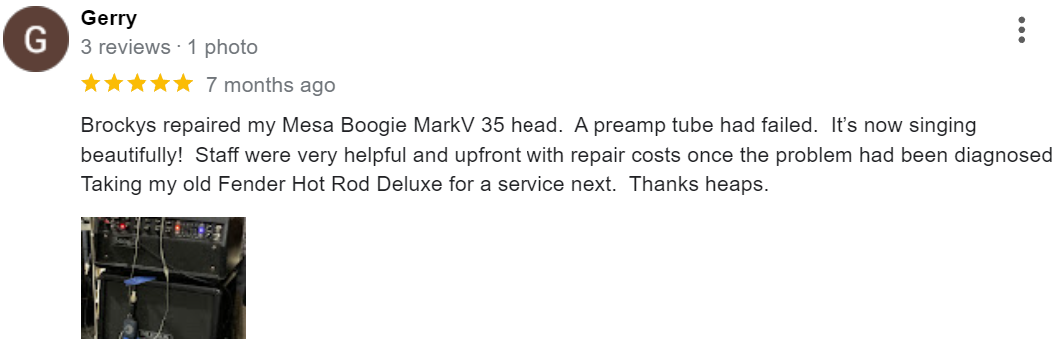
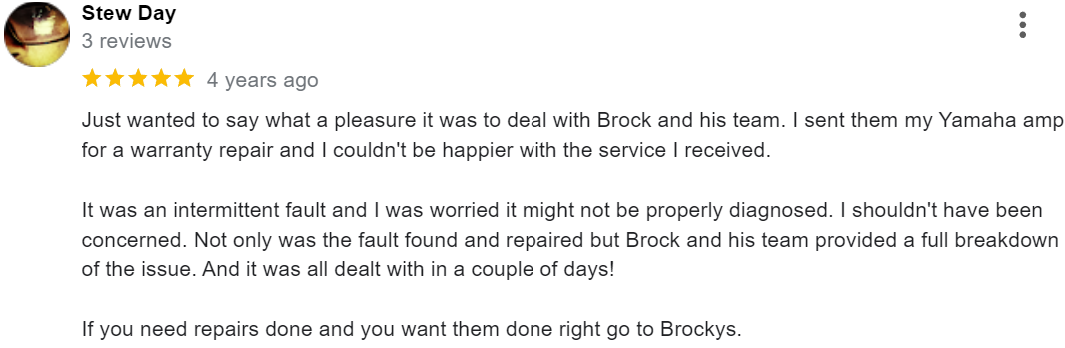
We’ll let the locals we’ve helped do the talking.
Get Your Music Equipment Maintained and Repaired Today
Don’t wait for a fault to disrupt a gig, a recording session, or a lesson. Whether it’s a professional service, a targeted repair, or honest advice on whether equipment is worth fixing, the team at Brocky’s Electronics is ready to help.
From music equipment maintenance and repair to televisions, digital pianos, and valve amplifiers, you can find everything we do at Brocky’s Electronics.
Contact Brocky’s Electronics today and we’ll have your equipment assessed and back in action as soon as possible.
FAQs
1. How often should I have my music equipment professionally serviced?
For regularly used equipment, an annual service is a good general rule. High-use items like mixing consoles and valve amplifiers benefit from more frequent checks in the Sunshine Coast’s humid coastal environment.
2. Can I clean potentiometers and faders myself?
Yes, using electronics-grade contact cleaner applied sparingly. Avoid generic lubricants or household cleaning products, which can damage contact surfaces. If cleaning doesn’t resolve crackling, the control needs professional replacement.
3. Does coastal humidity really damage music equipment?
Yes significantly. Salt air accelerates corrosion on metal contacts, circuit board traces, and connectors. Climate-controlled storage and regular maintenance reduce the impact considerably.
4. Is it worth repairing older music equipment?
For quality brands, almost always yes. A professional assessment tells you the repair cost versus replacement value before any work begins, so you’re never spending money without a clear picture of whether it makes sense.
5. Does Brocky’s Electronics repair all types of music equipment on the Sunshine Coast?
Yes. We repair mixing consoles, valve amplifiers, digital pianos, studio monitors, PA systems, and more across the Sunshine Coast, with honest assessments and upfront pricing before any work begins.