
If your piano hasn’t been tuned in a while, you might not even notice at first. The change is gradual. Notes start to sound slightly off, chords lose their clarity, and playing begins to feel less satisfying without you being able to pinpoint exactly why. Piano tuning is one of those maintenance tasks that’s easy to put off, but the longer it’s left, the more work the instrument needs to get back to where it should be.
Whether you own a classic upright, a grand piano, or a digital instrument that’s been playing up, the team at Brocky’s Electronics provides professional piano tuning and piano servicing across the Sunshine Coast. Here’s everything you need to know before booking your next tuning.
Why Does a Piano Go Out of Tune?
A piano going out of tune isn’t a sign of a poorly made instrument. It’s a natural consequence of how pianos are built and the environment they live in.
The main reasons a piano loses its tuning include:
- Humidity and temperature fluctuations — The Sunshine Coast’s warm, humid climate causes the piano’s soundboard to expand and contract with seasonal changes, shifting string tension and pitch
- String tension settling — Piano strings are under enormous tension, and over time that tension naturally relaxes, causing pitch to drop
- Regular playing — The physical act of playing shifts string tension incrementally with every session
- Moving the instrument — Even moving a piano within the same room can affect its tuning stability
On the Sunshine Coast, coastal humidity is a particularly significant factor. Pianos in homes close to the ocean or in rooms without climate control can go out of tune faster than those in more stable indoor environments.
How Often Should You Tune a Piano?
This is the most common question every piano tuner gets asked, and the honest answer depends on how the piano is used and where it lives.
General guidelines for Sunshine Coast piano owners:
- Twice a year is the standard recommendation for most home pianos played regularly
- Four times a year for pianos in teaching studios, schools, or performance spaces
- After every move regardless of how far the piano has travelled
- After purchase for any new or recently acquired piano, including instruments that have been in storage
- More frequently in coastal environments where humidity fluctuations are more pronounced
A common mistake is waiting until the piano sounds noticeably out of tune before booking a piano tuning on the Sunshine Coast . By that point, the instrument has often drifted so far from concert pitch that a single standard tuning isn’t sufficient to bring it back. A pitch raise may be needed first, which involves a separate preliminary pass before the fine tuning can be completed.
What Happens During a Professional Piano Tuning?
Understanding what a professional piano tuner actually does helps set realistic expectations for the process.
The Tuning Process
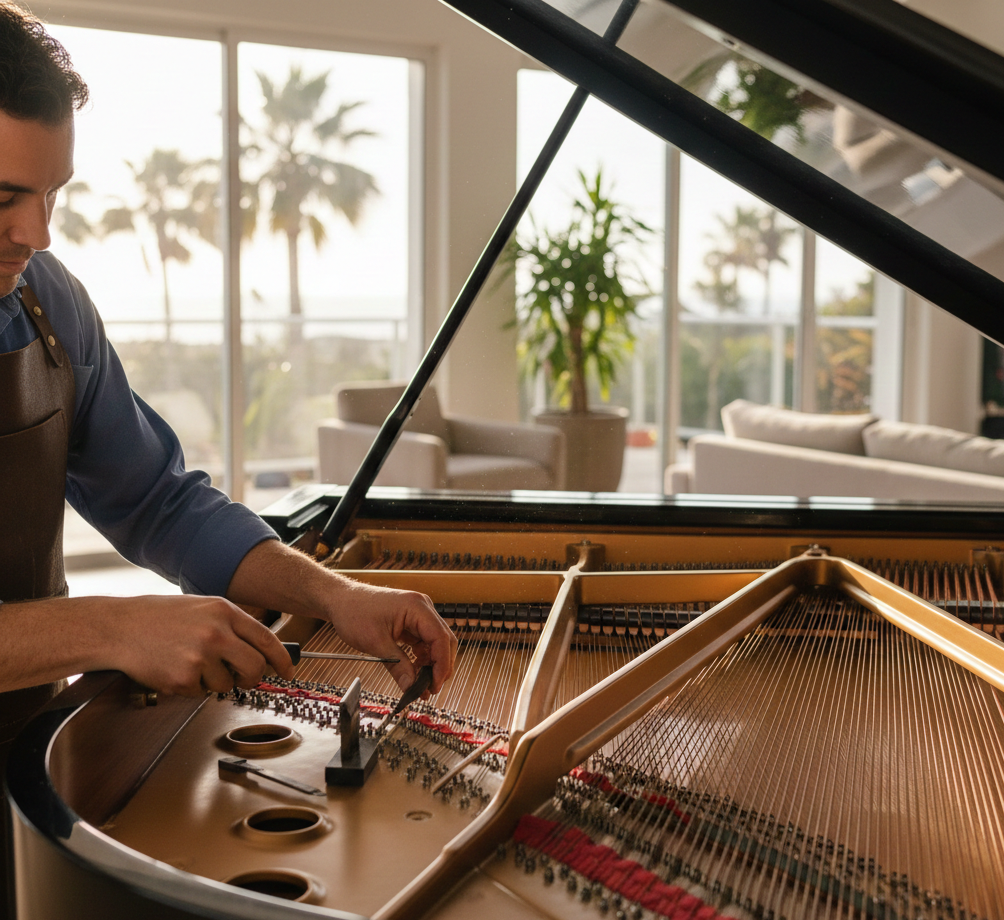
A professional piano tuning typically takes between 1 and 2 hours for a well-maintained instrument in reasonable condition. During that time, the tuner:

- Assesses the piano’s current pitch level relative to concert pitch (A440)
- Determines whether a pitch raise is needed before standard tuning can begin
- Works systematically through all strings, adjusting tension using a tuning hammer
- Sets the temperament across the keyboard so intervals sound correct across all octaves
- Checks and repeats adjustments as tension settles during the session
As covered in how piano tuning uses equal temperament to balance pitch across all keys, the process involves careful compromise across the instrument’s full range rather than simply matching each note to a fixed reference frequency.
What a Pitch Raise Involves
If a piano has dropped significantly below A440 which happens when tuning is left for several years a single fine tuning won’t hold. The increased string tension from raising pitch to concert level causes previously tuned strings to shift again. A pitch raise involves a faster pass through the entire instrument to bring it up to approximately the right level before the fine tuning pass begins. This means two passes rather than one, and is typically charged accordingly.
Signs Your Piano Needs Tuning Right Now
Not sure whether it’s time to call a piano tuner? These are clear signs your instrument needs attention:
- Chords sound dissonant or muddy even when played correctly
- The piano sounds noticeably different from recordings or other instruments you play alongside
- It’s been more than twelve months since the last piano tuning
- The piano has recently been moved or has been through a humid Sunshine Coast summer
- Students or family members are learning on it and noticing that notes sound wrong
Leaving a piano untuned for extended periods doesn’t just affect sound quality. It can cause uneven string tension that affects the instrument’s long-term structural condition.
Piano Tuning vs Piano Servicing: What’s the Difference?
Piano tuning is one specific part of keeping a piano in good condition. It addresses pitch and string tension. It doesn’t cover the mechanical action, sticky or broken keys, damper felt condition, or internal regulation.
A full piano service goes beyond tuning to cover:
- Regulation of the piano action for consistent key response
- Voicing of the hammers for tone quality
- Repair of broken or sticking keys
- Inspection and replacement of worn felt components
- Assessment of the pin block and bridge condition
If your piano has keys that stick, an uneven action, or tone that sounds harsh or dull even after tuning, a full service assessment is the next step.
If your setup also includes a digital piano with its own faults, digital piano repair on the Sunshine Coast covers everything from internal component repairs to key replacements across all major brands.
For digital piano pedal issues that need attention alongside your tuning visit, digital piano pedal not working fixes covers the most common causes and solutions.
Book Your Piano Tuning on the Sunshine Coast
Don’t leave your piano to drift further out of tune. Whether it’s a standard annual tuning, a pitch raise, or a full service assessment, the team at Brocky’s Electronics is ready to help.
From piano tuning and piano servicing to digital piano repairs and music equipment care, you can find everything we do at Brocky’s Electronics.
Contact Brocky’s Electronics today and we’ll get your piano sounding exactly the way it should.
We’ll let the locals we’ve helped do the talking.
FAQs
1. How often should I have my piano tuned on the Sunshine Coast?
Twice a year is the standard recommendation for most home pianos. Coastal humidity and temperature fluctuations mean Sunshine Coast pianos often benefit from more frequent tuning than inland instruments.
2. What is a pitch raise and does my piano need one?
A pitch raise is needed when a piano has dropped significantly below concert pitch. It involves a preliminary tuning pass before the fine tuning, and is typically needed when a piano hasn’t been tuned for several years.
3. How long does piano tuning take?
A standard tuning takes 1 to 2 hours for a well-maintained piano. A pitch raise adds additional time as two passes through the instrument are required.
4. Can humidity affect my piano’s tuning on the Sunshine Coast?
Yes significantly. The Sunshine Coast’s coastal humidity causes the soundboard to expand and contract, shifting string tension and pitch. Climate-controlled rooms help maintain tuning stability between visits.
5. What’s the difference between piano tuning and piano servicing?
Tuning addresses pitch and string tension only. A full service covers the mechanical action, key regulation, hammer voicing, and internal component inspection.