
There are few things more frustrating for a pianist than sitting down to practise and finding that some keys simply won’t respond. Whether it’s a single silent key, a group of keys that produce no sound, or keys that feel wrong underfoot, piano keys not working is one of the most common faults that brings Sunshine Coast musicians through our workshop door.
The good news is that not every case of piano keys not working points to a serious internal fault. Some causes are straightforward and identifiable at home before a technician is ever involved. Others signal deeper issues that worsen the longer they’re left. At Brocky’s Electronics, we carry out piano repair on the Sunshine Coast on both acoustic and digital instruments regularly. Here’s a clear, honest breakdown of what’s causing your keys to fail and what to do about each one.
Why Are My Piano Keys Not Working?
The answer depends significantly on whether you own an acoustic piano or a digital instrument. The internal mechanics are completely different, and identifying which type of fault you’re dealing with determines whether home checks are possible or whether professional piano repair on the Sunshine Coast is needed.
Piano Keys Not Working in Digital Pianos
1. Failed Key Sensor or Contact Strip
The most common reason for piano keys not working in a digital piano is a failed key sensor or a deteriorated contact strip beneath the key. Digital pianos use a rubber contact strip with two conductive points beneath each key. When a key is pressed, these contacts close a circuit that triggers the sound. When the contacts degrade or the rubber deteriorates, the key produces no sound or inconsistent response.
What you’ll notice:
- One or more specific keys produce no sound regardless of how hard they’re pressed
- A key responds intermittently, working sometimes and failing at others
- The fault doesn’t improve or worsen with the key mechanism physically
What to try first:
- Press the affected key firmly and slowly to confirm there’s no response at all
- Test in headphone mode to rule out a speaker fault rather than a key sensor fault
- Perform a factory reset and firmware update to rule out a software cause before assuming hardware failure
If the fault persists after these checks, the contact strip or key sensor needs replacement during a professional service.
2. Disconnected or Damaged Ribbon Cable
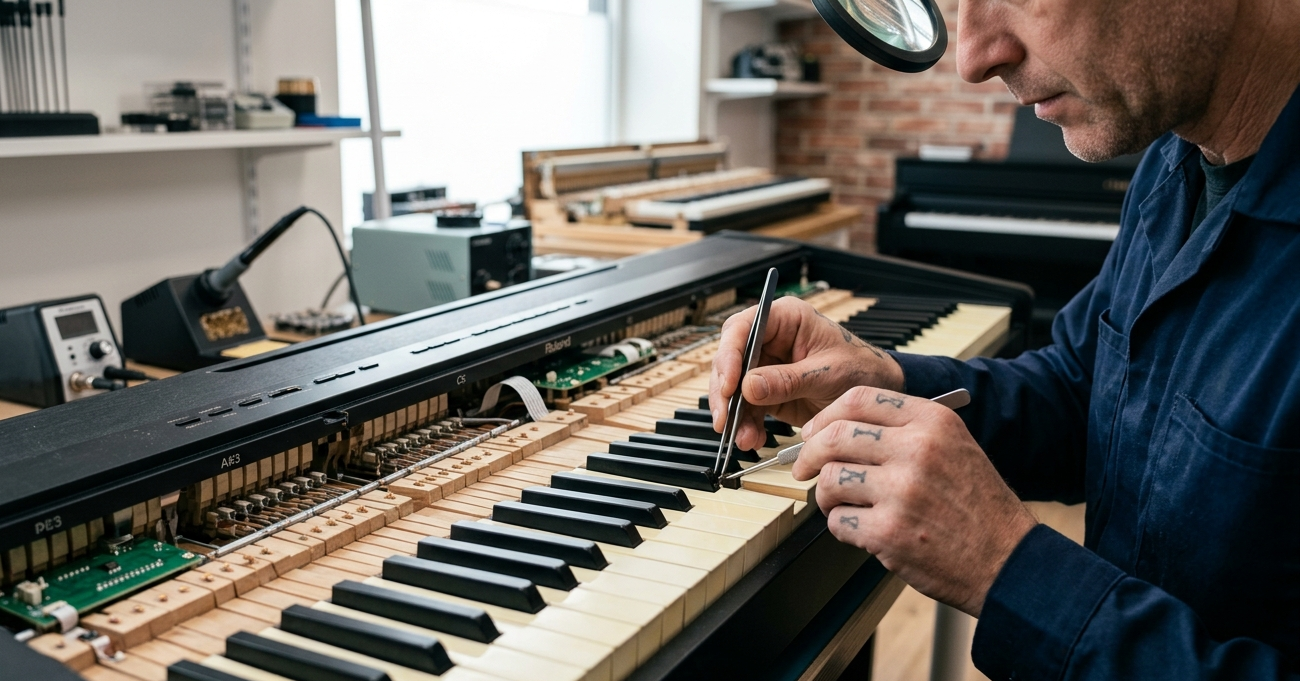
Digital pianos use ribbon cables to connect the key contact strips to the main board. A ribbon cable that has come partially unseated, been kinked during a previous repair attempt, or deteriorated over time can cause entire zones of piano keys not working simultaneously.
Signs of a ribbon cable fault:
- A whole section of keys, such as an octave or more, has stopped working at once
- The fault appeared after the piano was moved or transported
- Adjacent keys on either side of the silent zone work normally
Ribbon cable diagnosis and replacement requires opening the piano, accessing the key bed assembly, and reseating or replacing the affected cable. This is a professional repair job, as incorrect handling risks further damage to the cable or the contact strip connections.
3. Software or Firmware Fault
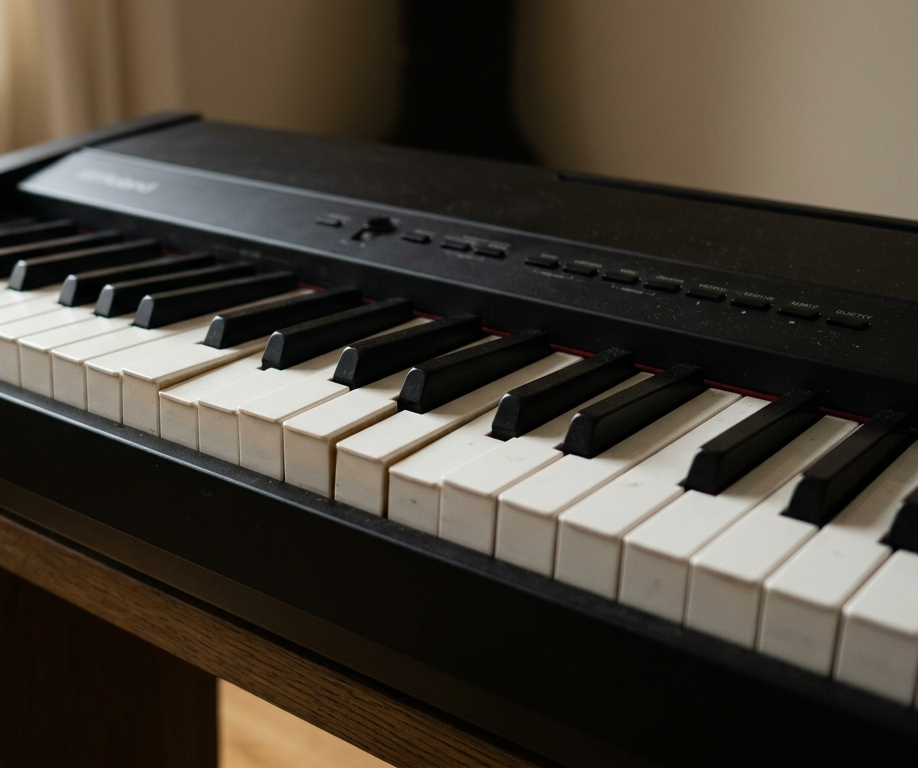
Piano keys not working in a digital instrument is sometimes caused by a software fault rather than hardware failure, particularly after a firmware update that didn’t complete correctly or on an instrument that has accumulated corrupted settings over time.
What to try:
- Update the firmware from the manufacturer’s official website
- Perform a factory reset after backing up any custom settings
- Check the manufacturer’s support page for known issues affecting your specific model
If specific keys remain unresponsive after a full firmware update and factory reset, the fault is hardware-related.
Piano Keys Not Working in Acoustic Pianos
4. Broken Hammer Shank or Hammer Head
In an acoustic piano, a key that produces no sound when pressed almost always indicates that the hammer mechanism has failed to strike the string. The most common cause is a broken or detached hammer shank, where the wooden shank connecting the hammer head to the action has snapped, typically from physical impact or prolonged stress.
What you’ll notice:
- The key travels down normally but produces a dead thud rather than a musical note
- No sound is produced even at full force
- Visually inspecting the action shows a hammer that doesn’t travel up when the key is pressed
Hammer shank replacement is a precise piano repair on the Sunshine Coast job that requires correct part matching and action regulation after installation to restore the key’s proper feel and response.
5. Broken or Missing String
A piano string that has snapped produces silence or a faint, dead tone rather than a clear note. String breakage is more common in older acoustic pianos where the strings have become brittle with age, and in instruments that have been subject to significant tension changes from a pitch raise.
Signs of a broken string:
- A single note is completely silent while adjacent notes on the same string course produce sound
- Inspecting inside the piano reveals a visibly broken or coiled string above the affected note
- The silent key has no apparent hammer or action fault
String replacement requires correct gauge matching, precise winding to the tuning pin, and retuning of the affected note and adjacent strings to re-equalise tension across the soundboard.
6. Stuck or Binding Action Components
Piano keys not working in the sense of keys that can’t be fully pressed or that travel inconsistently often points to a mechanical binding in the action rather than a complete component failure.
Common causes in acoustic pianos:
- Swollen wooden action components from humidity, particularly common in Sunshine Coast coastal homes
- Debris or foreign objects caught in the action mechanism
- Felt components that have compressed unevenly or torn
For a detailed look at what causes piano keys to feel physically wrong including sticking and excessive heaviness alongside complete failure, piano keys sticking or heavy causes and fixes covers the mechanical fault patterns in full.
As covered in how acoustic piano action mechanics work, the piano action involves a precise mechanical chain of components between the key and the hammer, and a fault in any one link of that chain produces silence or abnormal response at the key surface.
When Piano Keys Not Working Needs Professional Repair
Some preliminary checks are safe to try at home. But these are clear signs piano repair on the Sunshine Coast is needed rather than further DIY:
- Multiple keys are affected and basic checks haven’t identified an obvious cause
- The fault appeared after the piano was moved, transported, or exposed to liquid
- An acoustic piano key travels down normally but produces no sound
- A digital piano zone has gone completely silent after a firmware update and factory reset
- The fault is worsening progressively rather than remaining stable
For professional assessment and repair of digital instruments across all major brands, digital piano repair on the Sunshine Coast covers everything from key sensor replacements and ribbon cable repairs to full internal restorations.
If your setup also includes valve amplifiers or audio equipment that need attention alongside your piano, valve amplifier repair on the Sunshine Coast is handled by the same experienced local team at Brocky’s Electronics.
Why Sunshine Coast Musicians Trust Brocky’s Electronics
We’re a local workshop, not a mail-away repair centre. When you bring your piano to us, a qualified technician with real hands-on experience across acoustic and digital instrument repair assesses the fault honestly and explains every option before any work begins.
Here’s what you get with every piano repair on the Sunshine Coast at Brocky’s Electronics:
- Experienced technicians across all major digital piano brands including Yamaha, Roland, Kawai, and Casio
- Honest assessment, we’ll tell you if repair isn’t the right call
- Fast turnaround, because we know you can’t be without your instrument
- Genuine replacement parts wherever possible
- Transparent, upfront pricing with no surprises
We’ll let the locals we’ve helped do the talking.
Get Your Piano Keys Working Again Today
Don’t let piano keys not working keep you away from your instrument. Whether it’s a key sensor replacement, a ribbon cable repair, or a full acoustic action service, the team at Brocky’s Electronics is ready to help.
From piano keys not working repairs to valve amplifiers, televisions, and audio equipment, you can find everything we do at Brocky’s Electronics.
Contact Brocky’s Electronics today and we’ll have your piano assessed and back in playing condition as soon as possible.
FAQs
1. Why are some of my piano keys not working?
In digital pianos, failed key sensors or contact strips are the most common cause. In acoustic pianos, a broken hammer shank or string is usually responsible. A factory reset rules out a software cause in digital instruments before assuming hardware failure.
2. Can a factory reset fix piano keys that aren’t working?
Sometimes, if the cause is a firmware bug or corrupted settings. It won’t fix hardware faults, but it’s always worth trying first on a digital piano before booking a repair.
3. Why did an entire section of my digital piano keys stop working at once?
A whole section failing simultaneously almost always points to a ribbon cable fault rather than individual key sensor failures. This needs professional assessment and cable replacement.
4. Is it worth repairing piano keys not working on an older instrument?
In most cases yes, particularly for quality brands. A professional assessment gives you a clear answer on repair cost versus replacement value before any money is spent.
5. How long does a piano key repair take?
Most digital piano key repairs are completed within 3 to 7 business days. Acoustic action repairs may take longer depending on part availability and the extent of the work required.