

A well-functioning amplifier is the heart of any serious audio setup. When it starts distorting, cutting out, or producing no sound at all, it’s frustrating, and the cause isn’t always immediately obvious. The good news is that many amplifier repair jobs start with symptoms that are identifiable at home before a technician ever opens the chassis.
At Brocky’s Electronics, we carry out amplifier repair on everything from home hi-fi integrated amplifiers and valve power amps to PA systems and studio monitors across the Sunshine Coast. Understanding what the symptoms point to helps you communicate the fault clearly and gives a qualified technician a significant head start on diagnosis. Here’s what to look and listen for.
Start With the Basics Before Assuming the Amplifier Is at Fault
Before concluding that your amplifier needs repair, it’s worth ruling out the most common external causes. A significant number of faults that appear to be amplifier issues are actually caused by connected equipment, cables, or the signal source.
Work through these checks first:
- Swap your speaker cables to rule out a broken or shorted cable
- Test with a different set of speakers to confirm the fault isn’t in the speakers themselves
- Try a different input source to confirm the fault persists across inputs
- Check all cable connections are firmly seated at both the amplifier and connected equipment
- Confirm the amplifier is set to the correct input and that no muting function is engaged
If the fault persists after all of these checks, the issue is almost certainly in the amplifier itself.
The Most Common Amplifier Faults and What They Point To
1. No Sound Output on One or Both Channels
Complete loss of output is one of the most common reasons for amplifier repair on the Sunshine Coast. When one channel is silent and the other is working normally, the fault is almost always isolated to the affected channel’s circuitry rather than a power supply or shared component issue.
What causes it:
- A failed output transistor or output valve in valve amplifiers
- A blown channel protection fuse
- A failed driver stage component
- A faulty input or selector switch with oxidised contacts
What to check first:
- Confirm the balance control isn’t turned fully to one side
- Swap your left and right input cables to confirm whether the fault follows the input or stays on the same channel
- If the fault stays on the same channel regardless of input, the fault is in the amplifier’s channel circuitry
If both channels are completely silent with no output, the power supply or a shared protection circuit is the more likely cause.
2. Severe Distortion or Buzzing Signal
Distortion that wasn’t present before, particularly when it appears on one channel or at certain volume levels, is a common amplifier repair symptom pointing to a failing output stage component.
What causes it:
- A failing or mismatched output transistor or output valve
- Bias drift in valve or class AB amplifiers
- A degraded coupling capacitor distorting the signal path
- Clipping caused by the amplifier being driven beyond its rated output consistently
What you’ll notice:
- Harsh, gritty distortion that worsens at higher volumes
- Distortion that appears on one channel but not the other
- Clean sound that breaks up after the amplifier has been running for 20 to 30 minutes, pointing to a thermal fault
3. Persistent Hum or Buzz From Speakers
A low-frequency hum or buzz coming from the speakers even with no input signal connected is a classic amplifier repair symptom and one of the most common faults we diagnose on the Sunshine Coast.
Common causes:
- Failing or dried-out filter capacitors in the power supply
- A ground loop caused by connected equipment sharing multiple power paths
- A microphonic or failing valve in valve amplifier designs
- Degraded internal wiring or shielding
What to try first:
- Disconnect all inputs from the amplifier and check whether the hum persists with no source connected
- If the hum disappears with inputs disconnected, the source is likely a ground loop from connected equipment
- Try plugging all connected equipment into the same power outlet to reduce ground loop potential
- Switch to balanced XLR connections where available, as balanced connections reject common-mode hum effectively

If the hum is present even with all inputs disconnected, the fault is internal, and the power supply filter capacitors are the most likely culprit.
As covered in how audio amplifier circuits handle signal and noise, power supply filtering is critical to low-noise amplifier operation, and degraded electrolytic capacitors in this stage are one of the leading causes of persistent hum across all amplifier types.
4. Amplifier Going Into Protection Mode
Most modern solid-state amplifiers include a protection circuit that shuts the output stage down when it detects a fault condition, such as DC offset at the output, overcurrent, or overheating. An amplifier that repeatedly goes into protection mode is telling you something specific is wrong.
Common causes:
- A shorted or failing output transistor presenting DC at the output
- A speaker load the amplifier isn’t rated for, particularly below the minimum impedance rating
- Overheating caused by blocked ventilation or a failing cooling fan
- A fault in the protection circuit itself generating false triggers
What to check:
- Confirm the speaker impedance matches or exceeds the amplifier’s minimum rated load
- Ensure the amplifier has adequate ventilation on all sides
- Check whether the protection activates immediately at power-on, which points to an output stage fault, or only after extended use, which points to a thermal issue
5. Intermittent Audio Cutting In and Out
Intermittent faults are among the most challenging amplifier repair diagnoses because they don’t follow a predictable pattern. The audio cuts in and out, sometimes returning with a tap on the chassis, sometimes dropping for extended periods.
What causes it:
- Oxidised or corroded relay contacts in the output protection relay
- A cold or cracked solder joint on a heavily loaded component
- A failing potentiometer or selector switch with intermittent contact
- A loose internal connector that loses contact with vibration or temperature change
What you’ll notice:
- Audio that temporarily returns when the amplifier warms up or cools down
- Faults that respond to tapping or physical movement of the chassis
- Intermittent issues on specific inputs only, pointing to the selector switch or input circuitry
For a detailed breakdown of the most common causes of amplifier failure specifically in valve designs, what causes valve amplifiers to fail covers the fault patterns and diagnostic steps in full.
When to Stop Diagnosing and Call a Professional
Some of these checks are safe and informative to carry out at home. But these are clear signs your amplifier needs professional amplifier repair rather than further DIY investigation:
- Any fault involving the internal power supply or output stage components
- An amplifier that produces a burning smell or shows visible heat damage
- A valve amplifier with any internal fault, given the lethal voltages present inside
- Intermittent faults that don’t respond to any external check
- Physical damage to connectors, terminals, or the chassis
For valve amplifiers in particular, voltages between 300 and 500 volts DC remain present in filter capacitors for an extended period after shutdown, making internal investigation genuinely dangerous without proper discharge equipment and training.
If your setup also includes other music equipment needing attention, music equipment repair on the Sunshine Coast covers mixing consoles, studio monitors, PA systems, and more.
For further reading on amplifier circuit fundamentals that help make sense of these symptoms, Reverb’s tube amp troubleshooting resource is a practical reference for musicians and audio enthusiasts wanting to understand their equipment better.
Why Sunshine Coast Musicians and Audiophiles Trust Brocky’s Electronics
We’re a local workshop, not a mail-away repair centre. When you bring your amplifier to us, a qualified technician with real hands-on experience across valve and solid-state designs assesses it honestly, explains the fault clearly, and talks you through every option before any work begins.
Here’s what you get with every amplifier repair at Brocky’s Electronics:
- Experienced technicians across all major amplifier brands and types
- Honest assessment, we’ll tell you if repair isn’t the right call
- Fast turnaround, because we know you need your amp working
- Genuine and correctly specified replacement components wherever possible
- Transparent, upfront pricing with no surprises
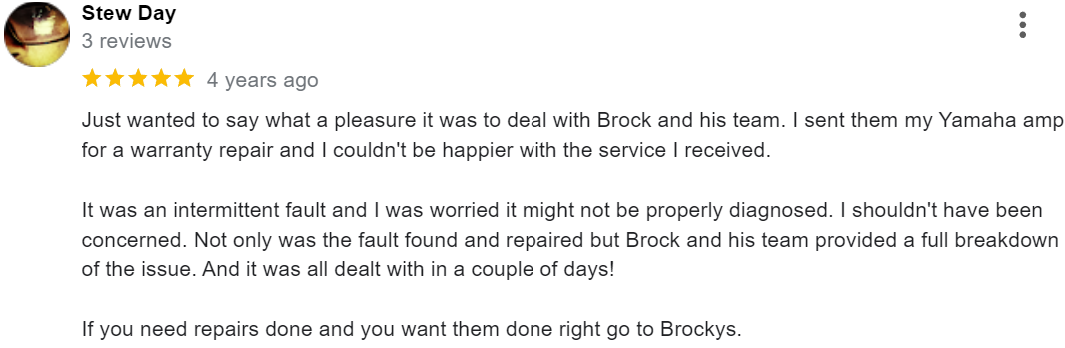
We’ll let the locals we’ve helped do the talking.
Book Your Amplifier Repair Today
Don’t leave an amplifier fault undiagnosed until it becomes something far more expensive to fix. Whether it’s a hum, a distorted channel, or complete loss of output, the team at Brocky’s Electronics is ready to help.
From amplifier repair to digital pianos, mixing consoles, and television servicing, you can find everything we do at Brocky’s Electronics.
Contact Brocky’s Electronics today and we’ll have your amplifier assessed and back in action as soon as possible.
FAQs
1. Why has my amplifier suddenly lost output on one channel?
A failed output component, blown channel fuse, or oxidised selector switch contacts are the most common causes. Swap your input cables first to confirm the fault is in the amplifier rather than the source.
2. Why does my amplifier hum even with nothing connected?
A hum that persists with all inputs disconnected points to a failing power supply filter capacitor or internal grounding issue. This needs professional diagnosis.
3. Why does my amplifier keep going into protection mode?
Protection mode is triggered by a fault condition such as DC offset, overcurrent, or overheating. Check your speaker impedance and ventilation first, then have the unit professionally assessed if the issue continues.
4. Is intermittent audio cutting in and out a serious fault?
It depends on the cause. Oxidised relay contacts and cold solder joints are repairable, but left unattended, intermittent faults typically worsen progressively.
5. How long does an amplifier repair take?
Most repairs are completed within 3 to 7 business days. Complex faults or parts sourcing may take a little longer, and we’ll always give you a realistic timeframe upfront.