
A great amplifier doesn’t just get louderit shapes every detail of what you hear. The warmth, the clarity, the dynamic range, and the way instruments separate in a mix are all products of an amplifier working exactly as it was designed to. When something inside begins to fail, that quality erodes gradually, and most listeners don’t realise how much they’ve lost until they hear the amplifier properly repaired and running correctly again.
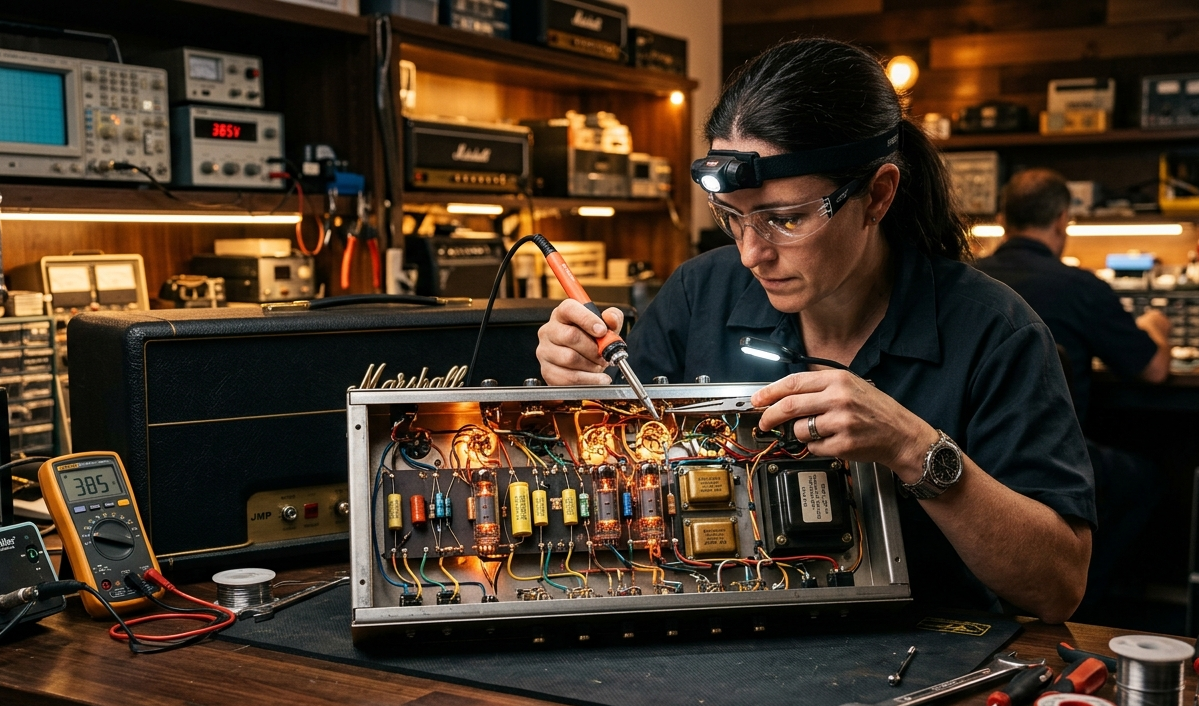
Amplifier repair is one of the most worthwhile investments a musician, audiophile, or home theatre enthusiast can make, particularly when the alternative is replacing a quality amplifier that has years of life left in it. At Brocky’s Electronics, we carry out amplifier repair on the Sunshine Coast on everything from vintage hi-fi integrated amplifiers to modern studio power amps and guitar amplifiers. Here’s how repair genuinely improves sound quality and what to look out for.
How Component Degradation Affects Amplifier Sound Quality
Most amplifier sound quality issues don’t develop overnight. They creep in gradually as internal components age, and the changes are subtle enough that many listeners adapt to them without noticing how far the sound has drifted from where it should be.
The components most responsible for gradual sound degradation include:
- Electrolytic capacitors that dry out over time, losing their ability to filter the power supply cleanly and introducing hum, noise, and loss of bass control
- Output transistors or valves that operate outside their design parameters as they age, causing distortion, loss of dynamics, and tonal changes
- Bias settings that drift as components age, pushing the output stage into a region where it produces significantly more distortion than it should
- Potentiometers and selector switches that develop oxidised contacts, causing channel imbalance, crackling on adjustment, and intermittent signal loss
- Coupling capacitors that change value over decades, affecting frequency response and introducing a veiled or coloured sound that wasn’t there originally
Professional amplifier repair addresses all of these systematically rather than simply cleaning the outside and hoping for the best.
The Most Common Amplifier Faults That Degrade Sound Quality
1. Increased Noise Floor and Hum
A persistent low-level hum or increased background noise that wasn’t present when the amplifier was new is one of the most common reasons Sunshine Coast audiophiles and musicians bring equipment in for amplifier repair on the Sunshine Coast.
Common causes:
- Failing electrolytic capacitors in the power supply no longer filtering mains ripple effectively
- A failing or microphonic valve in a valve amplifier design
- Oxidised ground connections increasing resistance in the signal path
- Degraded internal shielding allowing external interference to enter the circuit
A capacitor refresh in the power supply stage, sometimes called a recap, is one of the most reliably transformative amplifier repair procedures available for older equipment. The reduction in noise floor and the improvement in bass control and dynamic clarity it produces is often dramatic.
2. Loss of Dynamic Range and Impact
An amplifier that used to sound authoritative and dynamic but now sounds flat, compressed, or lacking in punch has almost certainly experienced component degradation in the output stage or power supply. This is a subtle fault that develops so gradually many owners don’t identify it as a technical problem until the amplifier is repaired.
What causes it:
- Power supply capacitors that can no longer deliver the instantaneous current the output stage demands during musical peaks
- Bias drift causing the output stage to operate inefficiently
- Failing output devices that can no longer swing to the full voltage rails
After a thorough amplifier repair addressing these issues, the improvement in dynamic impact and headroom is frequently one of the most commented-on results by Sunshine Coast customers who bring equipment to Brocky’s Electronics.
3. Distortion and Tonal Changes
An amplifier that has developed audible distortion, particularly on transients or at higher volume levels, or whose tonal character has shifted noticeably from how it sounded when new, is showing classic signs of output stage degradation or bias drift.
What you’ll notice:
- Harshness or grain in the upper frequencies that wasn’t present before
- Loss of the smooth, musical quality the amplifier was known for
- Distortion that appears at lower volume levels than it used to
- Valve amplifiers that sound increasingly coloured or compressed as output valves age
Valve amplifiers in particular benefit enormously from professional amplifier repair on the Sunshine Coast because their sonic character is so directly tied to the condition of the valves and the accuracy of the bias settings. As covered in how valve amplifier bias affects tonal character and distortion, the operating point of an output valve has a direct and measurable effect on the amplifier’s harmonic distortion profile, which is exactly what determines whether it sounds musical or harsh.
4. Channel Imbalance and Stereo Image Problems
A stereo image that has narrowed, shifted to one side, or lost its depth and separation is often caused by component mismatches between the two channels that have developed as parts age at different rates.
Common causes:
- Output devices that have drifted in their characteristics
- Channel-to-channel bias imbalance
- One channel’s coupling capacitors having changed value relative to the other
- Oxidised selector switch contacts affecting one channel more than the other
Restoring channel balance through amplifier repair brings back the stereo image that quality recordings are designed to reproduce, something that’s immediately and obviously audible in comparison.
5. Crackling, Intermittent Signal, and Control Noise
Crackling when adjusting volume, intermittent signal loss on one channel, or noise that responds to physical movement of the amplifier are all mechanical or contact-related faults that degrade the listening experience significantly and typically worsen if left unaddressed.
What causes it:
- Oxidised potentiometer tracks causing crackling and uneven volume control
- Dirty or corroded selector switch contacts causing intermittent signal loss
- Loose internal connections that lose contact with vibration or temperature change
- Cold solder joints that have developed over years of thermal cycling
Cleaning and exercising controls, combined with contact treatment on switches and connectors, resolves most of these issues during a professional amplifier repair on the Sunshine Coast service visit.
When to Book Professional Amplifier Repair
For a comprehensive look at the specific fault patterns that cause valve amplifiers to fail before they reach the point of audible degradation, what causes valve amplifiers to fail covers the diagnostic process and common fault patterns in full.
For professional amplifier repair on the Sunshine Coast covering both valve and solid-state designs, valve amplifier repair covers everything from bias adjustments and capacitor refreshes to full output stage rebuilds.
If your setup also includes other music equipment that needs attention alongside your amplifier, music equipment repair on the Sunshine Coast covers mixing consoles, studio monitors, digital pianos, and more.
For further reading on how amplifier maintenance affects long-term performance, Reverb’s practical resource on amplifier upkeep for musicians covers maintenance habits that complement professional repair in keeping your equipment sounding its best.
Why Sunshine Coast Musicians and Audiophiles Trust Brocky’s Electronics
We’re a local workshop, not a mail-away repair centre. When you bring your amplifier to us, a qualified technician with real hands-on experience across valve and solid-state designs assesses it honestly and explains every option before any work begins.
Here’s what you get with every amplifier repair at Brocky’s Electronics:
- Experienced technicians across all major amplifier brands and designs
- Honest assessment, we’ll tell you if repair isn’t cost-effective for your specific unit
- Fast turnaround, because we know you need your amplifier working
- Genuine and correctly specified replacement components wherever possible
- Transparent, upfront pricing with no surprises
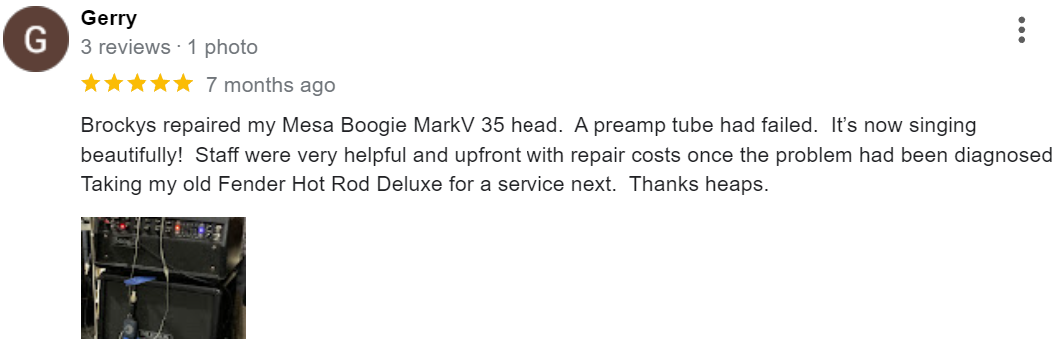
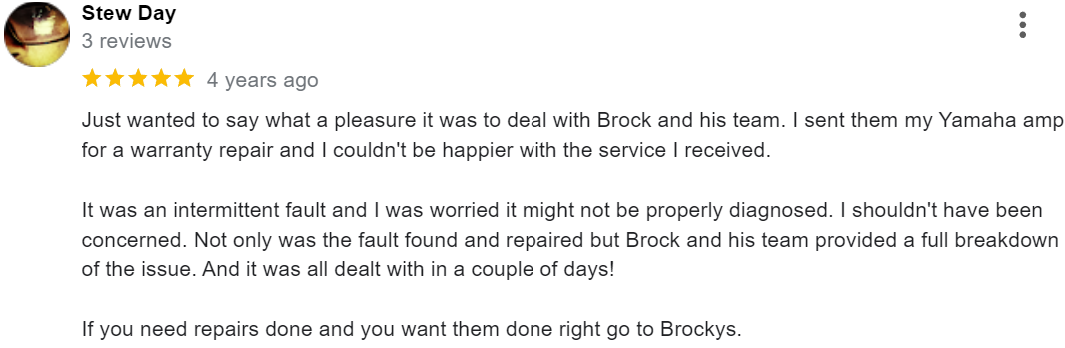
We’ll let the locals we’ve helped do the talking.
Book Your Amplifier Repair Today
Don’t let gradual component degradation rob your amplifier of the sound quality it was built to deliver. Whether it’s a capacitor refresh, a bias adjustment, or a full output stage repair, the team at Brocky’s Electronics is ready to help.
From amplifier repair on the Sunshine Coast to digital pianos, mixing consoles, and television servicing, you can find everything we do at Brocky’s Electronics.
Contact Brocky’s Electronics today and we’ll have your amplifier assessed and performing the way it was designed to as soon as possible.
FAQs
1. Can amplifier repair actually improve sound quality?
Yes significantly. Degraded capacitors, drifted bias settings, and aging output devices all reduce sound quality gradually. Professional repair restores the amplifier to its design specification, often producing a dramatic improvement.
2. How do I know if my amplifier needs repair or just a clean?
If the sound quality has changed, hum has increased, dynamics have compressed, or distortion has appeared, internal component repair is needed rather than a surface clean.
3. Is it worth repairing an older amplifier?
Almost always yes for quality brands. A well-executed amplifier repair on a quality unit costs significantly less than a comparable new amplifier and often produces a result the owner prefers to modern equivalents.
4. How long does amplifier repair take on the Sunshine Coast?
Most repairs are completed within 3 to 7 business days. Complex faults or parts sourcing may take a little longer, and we’ll always give you a realistic timeframe upfront.
5. What is a capacitor refresh and does my amplifier need one?
A capacitor refresh replaces the electrolytic capacitors in the power supply and signal path that have degraded over time. It’s recommended for any amplifier over 15 to 20 years old and produces noticeable improvements in noise floor, dynamics, and bass control.